ABSTRACT
Dye adsorption is one of the most time-consuming processes in the fabrication of dye-sensitized solar cells (DSSCs), typically requiring approximately 24 h at room temperature. In this study, the effect of adsorption temperature and time on photovoltaic performance of DSSCs was investigated in order to reduce processing time and improve device productivity. Nanoporous TiO2 photoelectrodes were immersed in N719 dye solution at 60°C for 3 h, 10 h, 17 h, and 24 h, and their performance was compared with that of cells sensitized at room temperature for 24 h. Photovoltaic characterization under AM 1.5 illumination showed that DSSCs sensitized at 60°C exhibited improved performance compared to those sensitized at room temperature. The device sensitized at 60°C for 3 h showed comparable or higher conversion efficiency than the reference cell sensitized for 24 h at room temperature. The improvement in device performance is attributed to enhanced dye adsorption kinetics resulting from increased reaction rate between the carboxyl groups of N719 dye molecules and hydroxyl groups on the TiO2 surface. Electrochemical impedance spectroscopy analysis revealed reduced recombination resistance at the TiO2/dye/electrolyte interface for cells sensitized at elevated temperature. UV–Vis absorption analysis confirmed increased dye loading on the TiO2 surface for the 60°C condition. These results demonstrate that elevated temperature dye adsorption significantly reduces processing time while maintaining photovoltaic performance, providing an effective strategy for improving manufacturing efficiency of DSSCs.
-
KEYWORDS: Dye-sensitized solar cells, Dye adsorption kinetics, TiO2 photoelectrode, N719 dye, Elevated temperature
1 Introduction
Dye-sensitized solar cells (DSSCs) have attracted significant attention as low-cost photovoltaic devices due to their simple fabrication process and relatively high power conversion efficiency under ambient conditions [
1–
3]. Since the first report by O’Regan and Grätzel, extensive research has been conducted to improve device performance through optimization of photoelectrode materials, sensitizers, and electrolyte systems [
1,
2].
In DSSCs, dye adsorption onto nanoporous TiO₂ photoelectrodes plays a critical role in determining device performance, as dye molecules are responsible for light absorption and electron injection into the conduction band of TiO₂ [
4,
5]. The adsorption process typically requires immersion of TiO₂ electrodes in dye solution for approximately 24 h at room temperature in order to achieve sufficient dye loading [
6,
7].
However, such long processing time limits manufacturing productivity and increases fabrication cost. Therefore, reducing dye adsorption time while maintaining sufficient dye loading is important for practical application of DSSCs. Dye molecules such as N719 contain carboxyl functional groups that chemically bond with hydroxyl groups on the TiO₂ surface, forming stable anchoring structures that enable efficient electron injection [
8].
The adsorption reaction rate is strongly influenced by temperature, as increased temperature enhances molecular diffusion and accelerates chemical bonding between dye molecules and TiO₂ surface sites [
9]. Elevated temperature adsorption may therefore reduce processing time while maintaining or improving dye loading. In this study, the effect of adsorption time at 60°C on photovoltaic performance of DSSCs was systematically investigated. Dye adsorption was carried out for 3 h, 10 h, 17 h, and 24 h at 60°C, and the results were compared with conventional adsorption at room temperature for 24 h. The influence of adsorption condition on dye loading, recombination resistance, and device efficiency was analyzed using UV–Vis spectroscopy and electrochemical impedance spectroscopy.
2 Experimental
2.1 Preparation of TiO2 Photoelectrodes
Fluorine-doped tin oxide (FTO) glass substrates (Pilkington TEC-8) were sequentially cleaned with acetone, methanol, and deionized (DI) water for 10 min each using ultrasonic treatment. After drying, a TiO₂ paste (Ti-Nanoxide HT/SP, Solaronix) was deposited onto the cleaned FTO substrates using a doctor-blading method. The thickness of the TiO₂ layer was approximately 10 μm, which is within the commonly reported thickness range for efficient DSSC photoelectrodes [
10]. The coated films were sintered at 600°C for 70 min to form a nanoporous TiO₂ structure.
The prepared TiO₂ electrodes were immersed in N719 dye solution for sensitization. For comparison of adsorption conditions, five groups of samples were prepared. The reference group was sensitized at room temperature for 24 h. The remaining groups were sensitized at 60°C using a hot plate for 3 h, 10 h, 17 h, and 24 h, respectively. Ethanol was used as the solvent for the N719 dye solution. The adsorption temperature was maintained at 60°C considering the boiling point of ethanol (78°C). After sensitization, the electrodes were rinsed with 99.9% ethanol (C₂H₅OH) to remove physically adsorbed dye molecules and then dried at room temperature.
2.2 Fabrication of DSSCs
The counter electrode was prepared by forming a platinum (Pt) catalytic layer with a concentration of 0.5 mM on FTO glass containing two pre-drilled holes. The dye-sensitized TiO₂ photoelectrode and Pt counter electrode were assembled into a sandwich structure using a sealing film. The electrodes were sealed by applying pressure using a hot iron at 120°C. Electrolyte was injected into the cell through the drilled holes, and the holes were subsequently sealed with cover glass to prevent electrolyte leakage. The assembled devices were used for photovoltaic characterization.
2.3 Characterization
Photovoltaic performance of the fabricated DSSCs was measured under AM 1.5 illumination (1,000 W/m²) using a solar simulator. Current density–voltage (J–V) characteristics were obtained to evaluate short-circuit current density (JSC), open-circuit voltage (VOC), fill factor (FF), and power conversion efficiency (η).
Electrochemical impedance spectroscopy (EIS) measurements were performed to analyze interfacial charge transfer characteristics at the TiO₂/dye/electrolyte interface.
The amount of dye adsorbed on the TiO₂ surface was evaluated by desorbing the dye molecules into a 0.1 M NaOH solution, followed by UV–Vis spectroscopy measurement. The absorbance spectra of N719 dye were measured in the wavelength range of 300–800 nm.
3 Results and Discussion
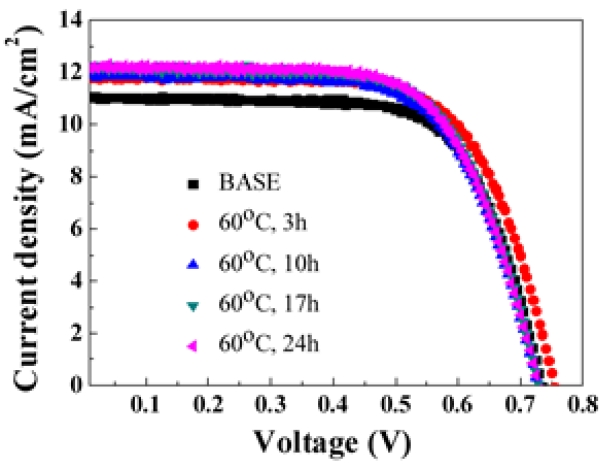
Figure 1 shows the current density–voltage (
J–V) characteristics of DSSCs fabricated under different dye adsorption conditions. The corresponding photovoltaic parameters are summarized in
Table 1. The reference device sensitized at room temperature for 24 h exhibited a conversion efficiency of 5.43%. As shown in
Figure 1, DSSCs sensitized at 60°C exhibited improved photovoltaic performance compared to the reference device sensitized at room temperature. In particular, the device sensitized at 60°C for 3 h showed the highest conversion efficiency of 5.90%, indicating that elevated temperature significantly improves dye adsorption effectiveness.
Table 1 summarizes the detailed photovoltaic parameters of DSSCs fabricated under different adsorption conditions. The short-circuit current density (
Jsc) increased from 11.09 mA/cm² for the reference device to 11.93 mA/cm² for the device sensitized at 60°C for 3 h, corresponding to approximately 7.6% improvement. This increase in
Jsc indicates enhanced light harvesting efficiency resulting from increased dye loading on the TiO₂ surface, which is strongly influenced by the surface characteristics and microstructure of TiO₂ photoelectrodes [
11]. The open-circuit voltage (
Voc) remained relatively constant in the range of 0.72–0.75 V regardless of adsorption condition. This result suggests that adsorption temperature does not significantly affect the energy level alignment between TiO₂ and the electrolyte. The fill factor (
FF) also showed only minor variation around 0.65, indicating that the internal resistance and overall charge transport characteristics were not significantly influenced by adsorption temperature. Among the tested conditions, the DSSC sensitized at 60 °C for 3 h exhibited the highest conversion efficiency of 5.90%. Increasing adsorption time beyond 3 h did not result in significant improvement in device performance, suggesting that sufficient dye coverage on the TiO₂ surface was achieved within a short sensitization time under elevated temperature conditions.
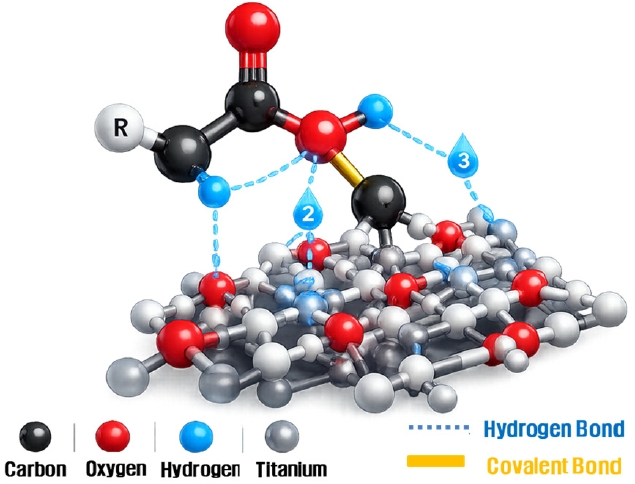
The adsorption of N719 dye molecules onto TiO₂ occurs through chemical bonding between carboxyl functional groups of the dye and hydroxyl groups on the TiO₂ surface.
Figure 2 schematically illustrates the adsorption mechanism of N719 dye molecules on the TiO₂ surface. The carboxyl functional groups of N719 dye molecules interact with hydroxyl groups on the TiO₂ surface, followed by coordination bonding between oxygen atoms of the dye and titanium atoms on the TiO₂ surface. These interactions provide stable anchoring of dye molecules, enabling efficient electron transfer from the excited dye molecules into the TiO₂ conduction band [
8,
9]. Although FT-IR analysis was not performed in this study, the proposed adsorption mechanism is consistent with previously reported interactions between carboxyl groups of Ru-based dyes and hydroxyl groups on TiO₂ surfaces [
8,
9]. The adsorption reaction is strongly influenced by temperature, as increased temperature enhances molecular diffusion and accelerates the formation of chemical bonds between dye molecules and available surface binding sites [
9].
Elevated temperature increases the probability of interaction between dye molecules and TiO₂ surface sites, leading to increased dye coverage within a shorter adsorption time. Similar saturation behavior of dye loading has been reported in previous DSSC studies [
6,
7]. Once most surface binding sites are occupied by dye molecules, further increase in adsorption time does not significantly improve device performance.
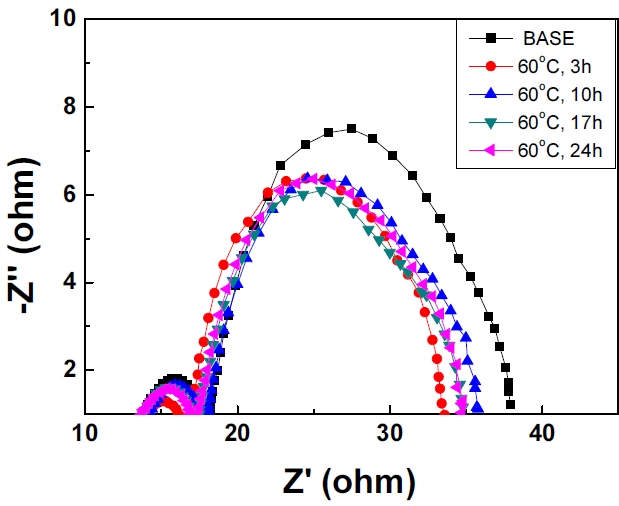
Electrochemical impedance spectroscopy (EIS) analysis was performed to investigate the influence of adsorption condition on interfacial charge transfer properties.
Figure 3 shows the Nyquist plots of DSSCs fabricated under different adsorption conditions. The semicircle observed in the middle frequency region corresponds to charge transfer resistance at the TiO₂/dye/electrolyte interface [
12,
13].
The DSSCs sensitized at 60°C exhibited smaller semicircle diameters compared to the reference device sensitized at room temperature, indicating reduced recombination resistance at the TiO₂/dye/electrolyte interface. Increased dye coverage reduces exposed TiO₂ surface trap sites, thereby suppressing recombination reactions between injected electrons and electrolyte species [
13–
15]. Reduced recombination contributes to improved charge transport efficiency and enhanced photocurrent density.
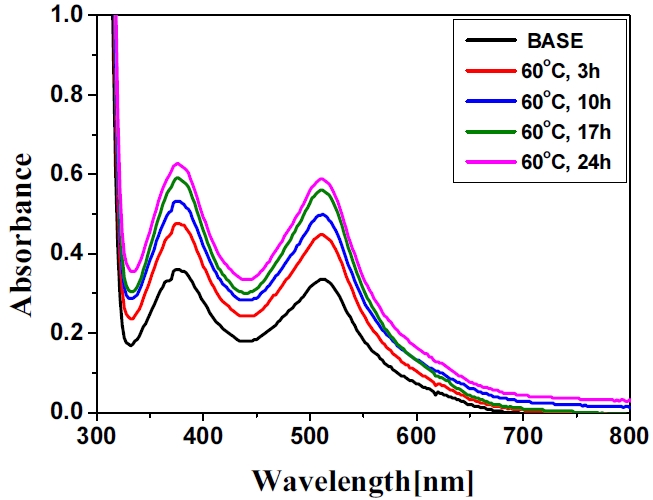
Figure 4 shows UV–vis absorption spectra of dye molecules desorbed from TiO₂ surfaces. The absorption peaks observed near 375 nm and 510 nm correspond to characteristic absorption wavelengths of N719 dye molecules [
16]. Increased absorbance intensity observed for samples sensitized at 60°C indicates increased dye loading compared to room temperature adsorption. The UV–Vis results support the
J–V characteristics presented in
Figure 1 and
Table 1, confirming that elevated temperature enhances dye adsorption kinetics and increases dye loading on the TiO₂ surface.
These results demonstrate that adsorption temperature significantly influences dye adsorption kinetics and interfacial charge transfer characteristics of DSSCs. The optimized adsorption condition of 60°C for 3 h effectively reduces sensitization time from 24 h to 3 h while maintaining or improving photovoltaic performance. Increasing adsorption time beyond 3 h does not significantly increase dye loading or device efficiency, indicating that adsorption equilibrium is reached rapidly under elevated temperature conditions [
17,
18].
4 Conclusion
The effect of dye adsorption time at elevated temperature on the photovoltaic performance of dye-sensitized solar cells was investigated. Dye adsorption at 60°C significantly reduced processing time while maintaining or improving device efficiency compared to conventional adsorption at room temperature for 24 h. Photovoltaic characterization demonstrated that DSSCs sensitized at 60°C for 3 h exhibited comparable or higher efficiency than the reference device sensitized for 24 h at room temperature. Electrochemical impedance spectroscopy analysis confirmed reduced recombination resistance, indicating improved charge transport properties due to increased dye loading.
The results indicate that elevated temperature adsorption accelerates chemical bonding between dye molecules and TiO₂ surface sites, enabling sufficient dye coverage within a shorter processing time. The proposed approach provides an effective strategy for improving manufacturing efficiency of DSSCs by reducing dye adsorption time.
Notes
-
Acknowledgement
This work was supported by the 2023 Research Fund of Ulsan College.
-
Conflict of Interest
The authors have no conflicts of interest to declare.
-
Author Contributions
Ba Wi Hwang: Conceptualization, Validation, Formal analysis.
Byungyou Hong: Supervision, Project administration, Funding acquisition.
Hyung Jin Kim: Writing - Original Draft, Writing - Review & Editing, Visualization, Funding acquisition.
Data Availability
Data available within the article or its supplementary materials.
Fig. 1.Current density–voltage (J–V) characteristics of DSSCs fabricated with different dye adsorption conditions under AM 1.5 illumination
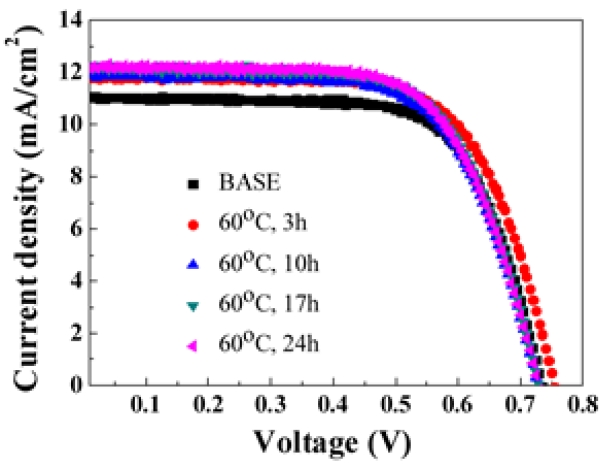
Fig. 2.Schematic illustration of the adsorption mechanism of N719 dye molecules on the TiO₂ surface through carboxyl anchoring groups. Hydrogen bonding and covalent coordination interactions between the carboxyl group of the dye and hydroxyl groups on the TiO₂ surface are shown
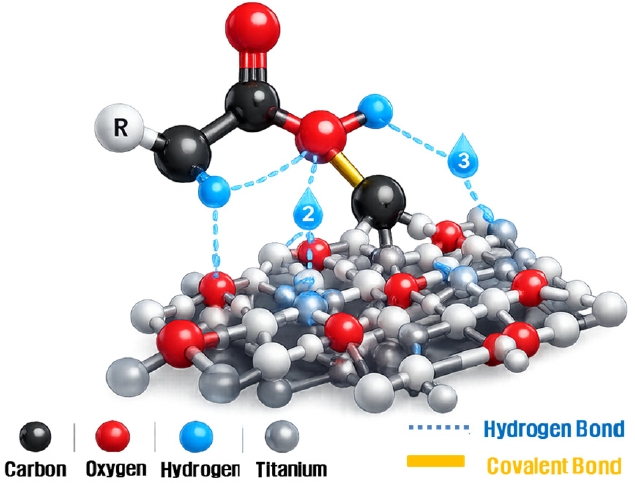
Fig. 3.Nyquist plots of DSSCs sensitized under different adsorption conditions ob-tained from electrochemical impedance spectroscopy
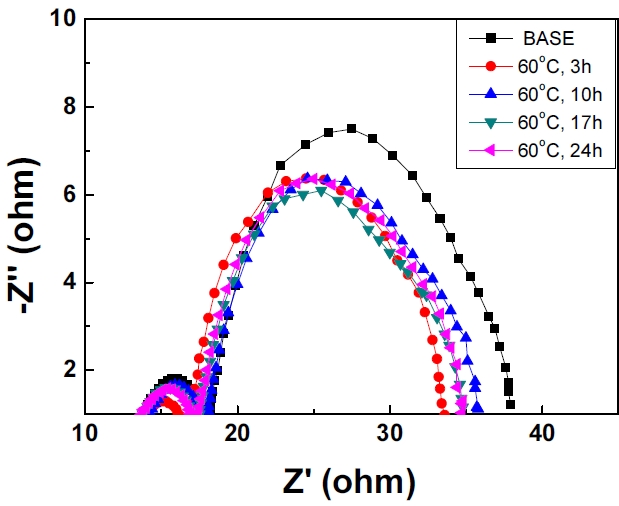
Fig. 4.UV–Vis absorption spectra of desorbed N719 dye molecules from TiO₂ surfaces under different adsorption conditions
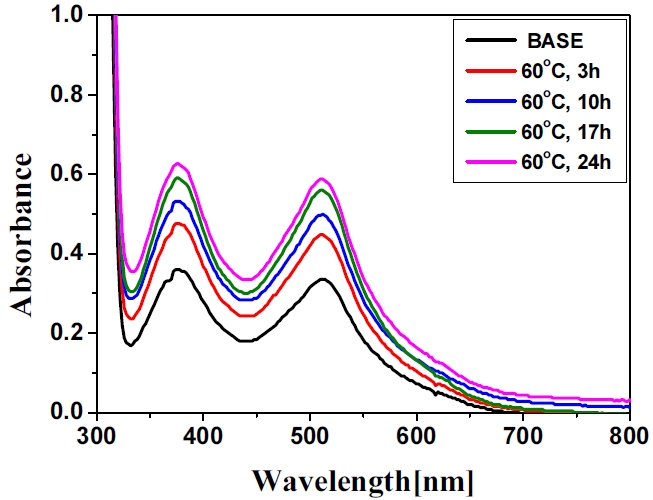
Table 1.Photovoltaic parameters (short-circuit current density (Jsc), open-circuit voltage (Voc), fill factor (FF), and power conversion efficiency (η)) of DSSCs fabricated under different dye adsorption conditions
Table 1.
|
Adsorption condition |
Jsc (mA/cm2) |
Voc (V) |
FF (%) |
CE (%) |
|
BASE |
11.09 |
0.73 |
66.92 |
5.43 |
|
60ºC, 3 h |
11.93 |
0.75 |
65.83 |
5.90 |
|
60ºC, 10 h |
11.95 |
0.72 |
64.92 |
5.62 |
|
60ºC, 17 h |
12.25 |
0.73 |
65.41 |
5.82 |
|
60ºC, 24 h |
12.30 |
0.72 |
64.99 |
5.79 |
References
- 1. B. O'Regan and M. Grätzel, Nature, 353, 737 (1991). doi: https://doi.org/10.1038/353737a0
- 2. M. Grätzel, J. Photochem. Photobiology C Photochem. Rev., 4, 145 (2003). doi: https://doi.org/10.1016/S1389-5567(03)00026-1
- 3. Y. Chiba, A. Islam, Y. Watanabe, R. Komiya, N. Koide, and L. Han, Jpn. J. Appl. Phys., 45, L638 (2006). doi: https://doi.org/10.1143/JJAP.45.L638
- 4. B. C. O’Regan and J. R. Durrant, Acc. Chem. Res., 42, 1799 (2009). doi: https://doi.org/10.1021/ar900145z
- 5. A. Hagfeldt, G. Boschloo, L. Sun, L. Kloo, and H. Pettersson, Chem. Rev., 110, 6595 (2010). doi: https://doi.org/10.1021/cr900356p
- 6. S. Ito, T. N. Murakami, P. Comte, P. Liska, C. Grätzel, M. K. Nazeeruddin, and M. Grätzel, Thin Solid Films, 516, 4613 (2008). doi: https://doi.org/10.1016/j.tsf.2007.05.090
- 7. S. Y. Kwon, W. Yang, and Z. H. Zhang, J. Korean Inst. Electr. Electron. Mater. Eng., 27, 746 (2014). doi: https://doi.org/10.4313/JKEM.2014.27.11.746
- 8. K. Kalyanasundaram, Coord Chem. Rev., 177, 347 (1998). doi: https://doi.org/10.1016/s0010-8545(98)00189-1
- 9. Y. Tachibana, J. E. Moser, M. Grätzel, D. R. Klug, and J. R. Durrant, J. Phys. Chem., 100, 20056 (1996). doi: https://doi.org/10.1021/jp962227f
- 10. H. S. Park, S. Y. Kwon, and W. Yang, J. Korean Inst. Electr. Electron. Mater. Eng., 25, 537 (2012). doi: https://doi.org/10.4313/JKEM.2012.25.7.537
- 11. A. R. Park, S. H. Kim, D. G. Kim, H. B. Gu, and H. C. Ki, J. Korean Inst. Electr. Electron. Mater. Eng., 25, 620 (2012). doi: https://doi.org/10.4313/JKEM.2012.25.8.620
- 12. Q. Wang, S. Ito, M. Grätzel, F. Fabregat-Santiago, I. Mora-Seró, J. Bisquert, T. Bessho, and H. Imai, J. Phys. Chem. B, 110, 25210 (2006). doi: https://doi.org/10.1021/jp064256o
- 13. J. Bisquert, J. Phys. Chem. B, 106, 325 (2002). doi: https://doi.org/10.1021/jp011941g
- 14. N. Kopidakis, E. A. Schiff, N. G. Park, J. van de Lagemaat, and A. J. Frank, J. Phys. Chem. B, 104, 3930 (2000). doi: https://doi.org/10.1021/jp9936603
- 15. L. Han, N. Koide, Y. Chiba, and T. Mitate, Appl. Phys. Lett., 84, 2433 (2004). doi: https://doi.org/10.1063/1.1690495
- 16. F. Fabregat-Santiago, G. Garcia-Belmonte, I. Mora-Seró, and J. Bisquert, Phys. Chem. Chem. Phys., 13, 9083 (2011). doi: https://doi.org/10.1039/C0CP02249G
- 17. J. van de Lagemaat and A. J. Frank, J. Phys. Chem. B, 104, 4292 (2000). doi: https://doi.org/10.1021/jp000836o
- 18. Q. Wang, J. Moser, and M. Grätzel, J. Phys. Chem. B, 109, 14945 (2005). doi: https://doi.org/10.1021/jp052768h