ABSTRACT
We have studied the thermal stability of NCM622 cathode material for Li-ion batteries using real-time synchrotron x-ray scattering below 600°C in both air and vacuum. The expansion of the mean particle size, which reached maximum values of 10.3 μm in air and 10.6 μm in vacuum at 200°C, was attributed to the dehydration of intergranular water within the NCM622 powders. Across all annealing temperatures, the amount of crystal NCM622 phase in air was consistently higher than that in vacuum. The crystal domain sizes in air showed less variation than that in vacuum during annealing from RT to 500°C. These indicate that the crystal NCM622 phase is more thermally stable during annealing in air than in vacuum. This stability is attributed to the presence of 21% oxygen in air, which is absent under vacuum conditions.
-
KEYWORDS: Li-ion batteries, NCM622 cathode material, Thermal stability, Real-time synchrotron x-ray scattering
1 Introduction
Li-ion batteries are gaining significant attention as a key technology for high-tech industries, owing to their superior characteristics such as high energy density and rapid charge/discharge rates compared to conventional secondary batteries [
1–
3]. However, there is a risk of explosion if the separator between the cathode and anode is damaged by mechanical impact or degraded by exposure to high temperatures [
4,
5]. LiNiCoMnO₂ (NCM) oxide is a cathode material in which Co and Mn are added to conventional LiNiO₂ to enhance electrochemical stability [
6–
8]. The NCM cathode material undergoes a phase transition from a layered structure to a rock salt structure at temperatures around 700°C [
9]. The phase transition occurs due to the precipitation of Li
2O phase, which obstructs the movement of Li-ions [
9]. Therefore, the thermal stability of the NCM cathode material at temperatures below 700°C is important, as this range covers both practical operation and potential thermal excursion events. LiNi
0.6Co
0.2Mn
0.2O
2 (NCM622) cathode material has been used as batteries for electric vehicles requiring high energy density [
10]. The thermal stability of the NCM622 cathode material below 700°C, however, has not been well characterized.
In this article, we present a real-time synchrotron x-ray scattering study to examine the thermal stability of the NCM622 cathode material during annealing below 600°C in both air and vacuum. Synchrotron x-ray scattering with very high flux and high resolution is one of the most effective ways to examine the detailed behaviors of advanced materials during annealing [
11,
12]. Our study provided the detailed thermal stability of the NCM622 cathode material during real-time annealing below 600°C in both air and vacuum.
2 Experimental Details
The NCM622 cathode powders were synthesized by dry mixing NCM622 precursor powder (Ni
0.6Co
0.2Mn
0.2 (OH)
2) and lithium carbonate (Li
2CO
3, 99%, Sigma-Aldrich) via ball milling, followed by sintering in the air using a high-temperature electric furnace [
13]. The NCM precursor powders were synthesized by co-precipitation method, in which metal sulfates were dissolved in distilled water with NaOH and NH
4OH to induce precipitation [
14]. The surface micrographs and chemical composition of the NCM622 cathode powders were investigated using scanning electron microscope coupled with energy dispersive spectroscopy (SEM-EDS). The NCM622 powders were annealed at various temperatures from room temperature (RT) to 600°C for 30 minutes. The chemical composition of the NCM622 powders indicated LiNi
0.62Co
0.20Mn
0.18O
2, similar to LiNi
0.6Co
0.2Mn
0.2O
2 (NCM622). The mean particle size of the NCM622 powders was quantitatively determined through image analysis based on the SEM micrographs. In the meanwhile, the real-time synchrotron x-ray scattering experiments were performed at beamline 5D (GIST) at Pohang Light Source in Korea. The incident x-rays were vertically focused by a mirror, and monochromatized to a wavelength of 1.240 Å. The experiments were carried out by measuring the x-ray powder diffraction profiles during annealing in air and in vacuum. The vacuum pressure was 3.0×10
-3 Torr using rotary pump. The NCM622 cathode powders were annealed using a heating stage, which was set on a four-circle x-ray diffractometer for real-time xray measurements. The annealing temperature increased gradually and stayed constant during the x-ray measurements.
3 Results and Discussion
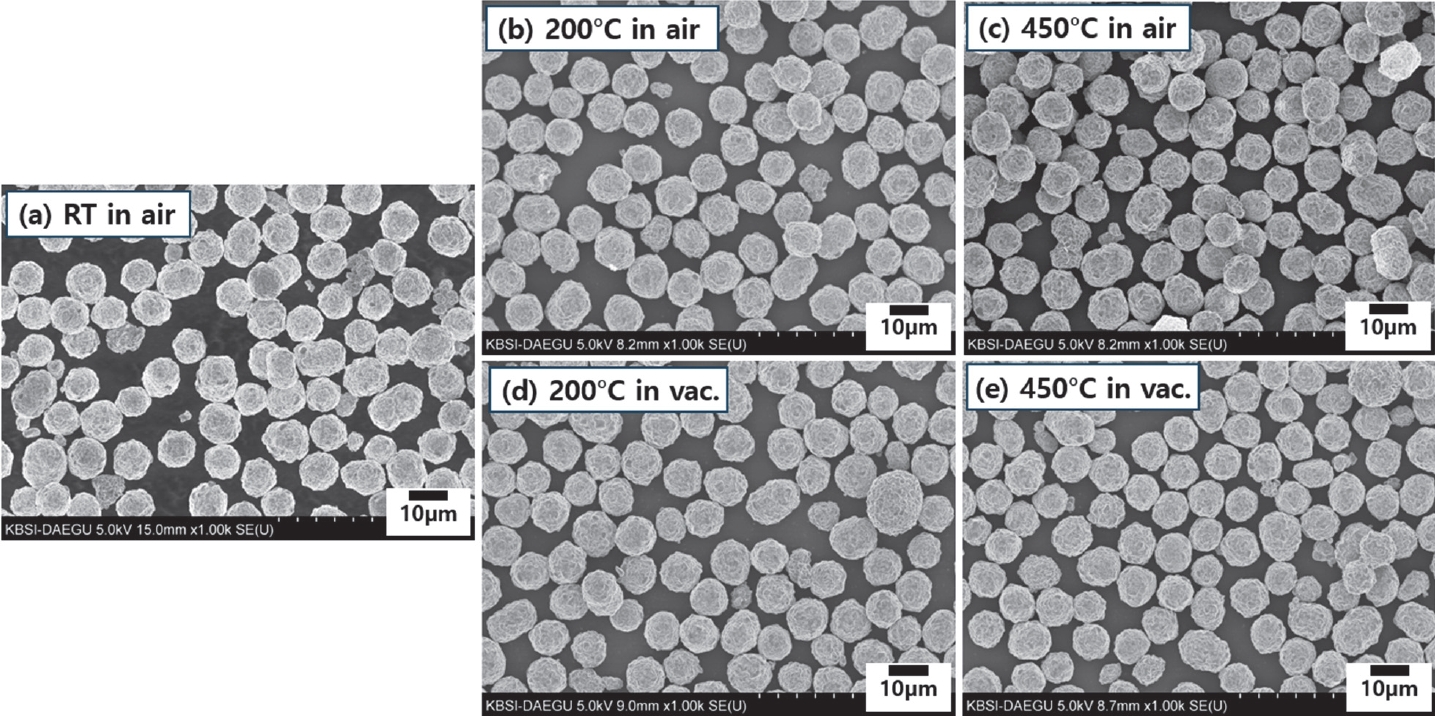
Figure 1 shows the surface SEM micrographs of NCM622 cathode powders annealed at several temperatures in air (a–c) and vacuum (d, e). As shown in
Fig. 1(a), the NCM622 powders at RT exhibited a nearly spherical shape with a highly uniform particle size distribution. After post-annealing up to 600°C in both air and vacuum, the shape of the powders was remained spherical, and the particle size distribution was very uniform. In addition, the mean particle size of the NCM622 powders was quantitatively determined through image analysis based on the SEM micrographs.
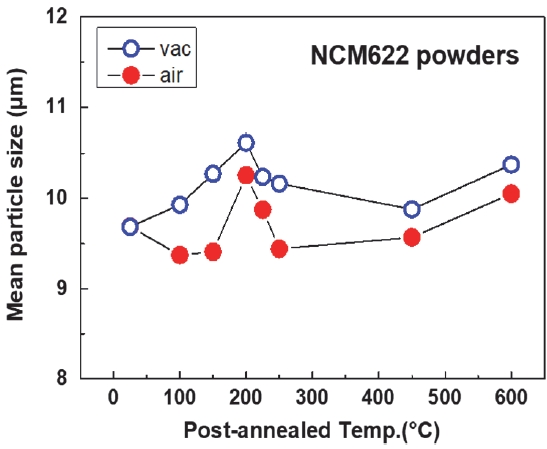
Figure 2 shows the mean particle sizes of NCM622 cathode powders at various annealing temperatures, ranging from RT to 600°C, in both air and vacuum. At RT in air, the mean particle size of the NCM622 powders was 9.7 μm. At all post-annealing temperatures, the mean particle sizes of the powders in air were smaller than those in vacuum. In air, the mean particle size of the powders increased to 10.3 μm at 200°C and then dropped to 9.4 μm at 250°C. In vacuum, the mean particle size increased linearly to 10.6 μm at 200°C and then decreased to 10.2 μm at 250°C. Meanwhile, the mean particle size of the NCM622 powders with a layered structure showed an increasing trend at 200°C in both air and vacuum [
9]. We believe that this is related to the existence of intergranular water within the NCM622 powders [
15]. The moisture to be absorbed into the NCM powders from the ambient air can remain in the form of LiOH·H
2O in the intergranular regions [
16].
Real-time synchrotron x-ray scattering experiments with very high flux and high resolution were performed during annealing of the NCM622 cathode powders in both air and vacuum.
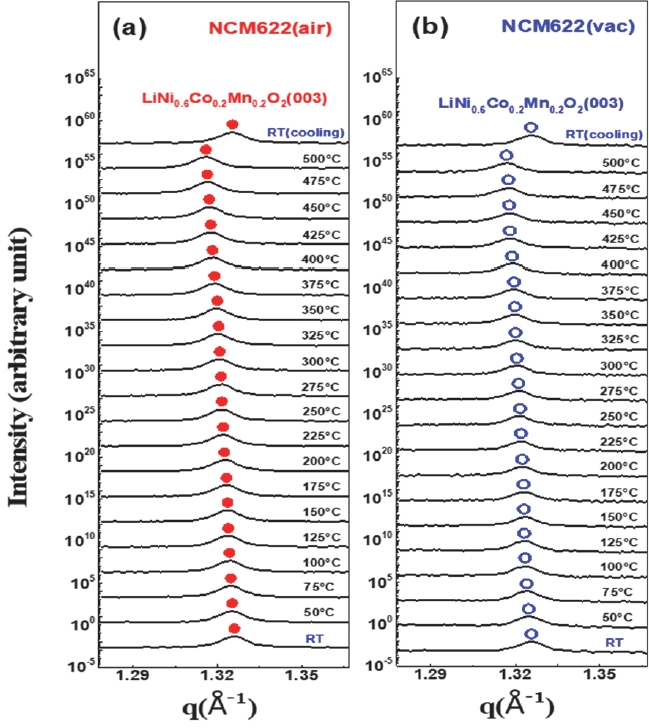
Figure 3 shows the synchrotron x-ray diffraction profiles of NCM622 powders at various temperatures during annealing in (a) air and (b) vacuum. Note that data were shifted in y-axis for clarity.
Figure 3(a) shows the synchrotron x-ray diffraction profiles of the NCM622 powders as a function of annealing temperature in air. At RT, the NCM(003), NCM(101), NCM(006), and NCM(012) Bragg reflections with a rhombohedral crystal structure were observed at
q=1.326,
q=2.568,
q=2.655, and
q=2.681 Å
-1, respectively (data not shown) [JCDPS 74-0917]. The real-time synchrotron x-ray scattering experiments were performed while increasing the annealing temperature, focusing on the NCM(003) reflection, which exhibits the highest relative intensity. As the annealing temperature increased, the NCM(003) reflections continuously shifted to the left due to thermal expansion.
Figure 3(b) also shows the synchrotron x-ray diffraction profiles of the NCM622 powders as a function of annealing temperature in vacuum. At RT, the NCM(003), NCM(101), NCM(006), and NCM(012) Bragg reflections were observed at
q = 1.326,
q = 2.568,
q = 2.652, and
q = 2.681 Å
-1, respectively (data not shown). As the annealing temperature increased, the NCM(003) reflections also continuously shifted to the left due to thermal expansion.
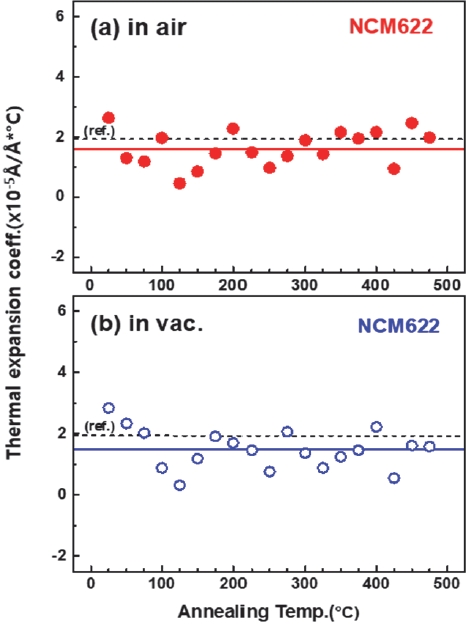
Figure 4 shows the thermal expansion coefficients of the (003) Bragg reflection for NCM622 cathode powders as a function of annealing temperature in (a) air and (b) vacuum. The thermal expansion coefficient of NCM622 powders has been previously reported as 1.95×10
-5 Å/(Å°C) (dotted line) [
17].
Figure 4(a) shows the thermal expansion coefficients derived from the shift in the NCM(003) reflection position during annealing in air. The mean thermal expansion coefficient (solid line), calculated from RT to 500°C in air, was 1.62×10
-5 Å/(Å°C), which was slightly smaller than the previously reported value of 1.95×10
-5 Å/(Å°C) [
17].
Figure 4(b) also shows the thermal expansion coefficients derived from the NCM(003) reflection positions during annealing in vacuum. The mean thermal expansion coefficient (solid line), calculated from RT to 500°C in the air, was 1.49×10
-5 Å/(Å°C), which was smaller than the previously reported value of 1.95×10
-5 Å/(Å°C) [
17]. The mean thermal expansion coefficient of NCM622 powders in air was 1.62×10
-5 Å/(Å°C), which was slightly larger than that in vacuum, 1.49×10
-5 Å/(Å°C). In addition, after cooling to RT, the NCM(003) reflection was observed at
q=1.326 Å
-1, and showed the same
q value as before annealing at RT.
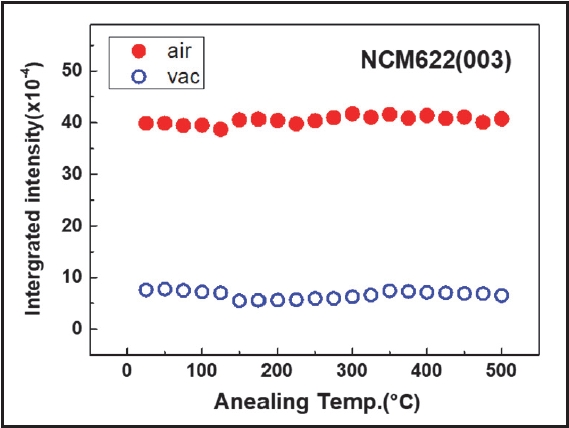
Figure 5 shows the x-ray integrated intensities of the NCM622(003) Bragg reflections as a function of annealing temperature in both air and vacuum. The integrated intensity stands for the amount of crystal NCM622 phase quantitatively [
11,
12]. The amount of crystal NCM622 phase in both air and vacuum remained almost constant, regardless of the annealing temperature. Furthermore, across all annealing temperatures, the crystal NCM622 phase content in air was consistently higher than that in vacuum. This indicates that the crystal NCM622 phase is more thermally stable during annealing in air than in vacuum. This stability is attributed to the presence of 21% oxygen in air, which is absent under vacuum conditions [
18].
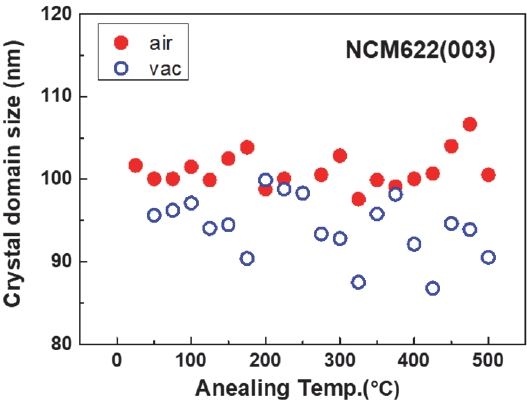
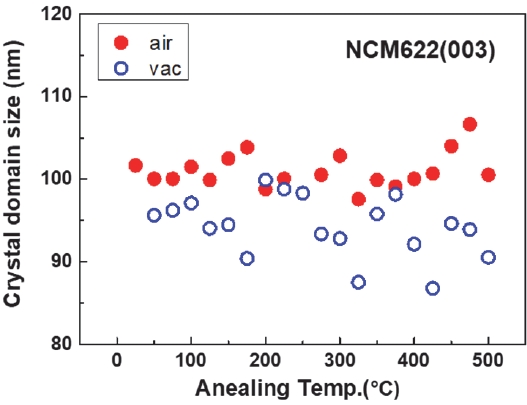
Figure 6 shows the crystal domain sizes of the NCM622 phase within a particle as a function of annealing temperature in both air and vacuum. The crystal domain size wtihin a particle was estimated from the full-width at half-maximum (FWHM) of the NCM(003) Bragg reflection using the Scherrer equation [
19]. At RT in air, the crystal domain size of the NCM622 phase within a particle was 101.7 nm (0.1 μm), which is significantly smaller than the mean particle size of 9.7 μm. Across most annealing temperatures, the crystal domain sizes of the NCM622 phase in air were larger than those in vacuum. Furthermore, the crystal domain size in air showed less variation than that in vacuum during annealing from RT to 500°C. These results indicate that the crystal NCM622 phase in air exhibits greater thermal stability than that in vacuum during annealing from RT to 500°C. This is attributed to the presence of 21% oxygen in air, which is absent in vacuum [
18].
4 Conclusion
The thermal stability of NCM622 cathode material for Li-ion batteries was studied by using a real-time synchrotron x-ray scattering at temperatures below 600°C in both air and vacuum. The expansion of the mean particle size, which reached maximum values of 10.3 μm in air and 10.6 μm in vacuum at 200°C, was attributed to the dehydration of intergranular water within the NCM622 powders. Real-time synchrotron x-ray scattering further elucidated the thermal stability of the NCM622 oxide powders during annealing. Across all annealing temperatures, the amount of crystal NCM622 phase in air was consistently higher than that in vacuum. The crystal domain sizes in air showed less variation than that in vacuum during annealing from RT to 500°C. These results indicate that the crystal NCM622 phase in air exhibits greater thermal stability than that in vacuum during annealing. This stability is attributed to the presence of 21% oxygen in air, which is absent under vacuum conditions. Our study provided the detailed thermal stability of NCM622 cathode material during annealing below 600°C in both air and vacuum.
Notes
-
Acknowledgement
This research was supported by Kyungpook National University. This research was helped by Pohang Accelerator Laboratory in Korea. The authors also acknowledge Mr. K. J. Hwang for his contribution to SEM-EDS experiments in the Korean Basic Science Institute (Busan Center).
-
Conflict of Interest
The authors have no conflicts of interest to declare.
-
Author Contributions
Seung-Han Lee: Conceptualization, Data curation, Visualization, Investigation, Formal analysis, Writing – original draft.
Tae-Sik Cho: Conceptualization, Data curation, Visualization, Investigation, Formal analysis, Funding acquisition, Methodology, Project administration, Resources, Software, Supervision, Validation, Writing – review & editing.
Data Availability
Data available on request from the authors.
Fig. 1.SEM micrographs of NCM622 cathode powders as a function of post-annealed temperature in both air and vacuum
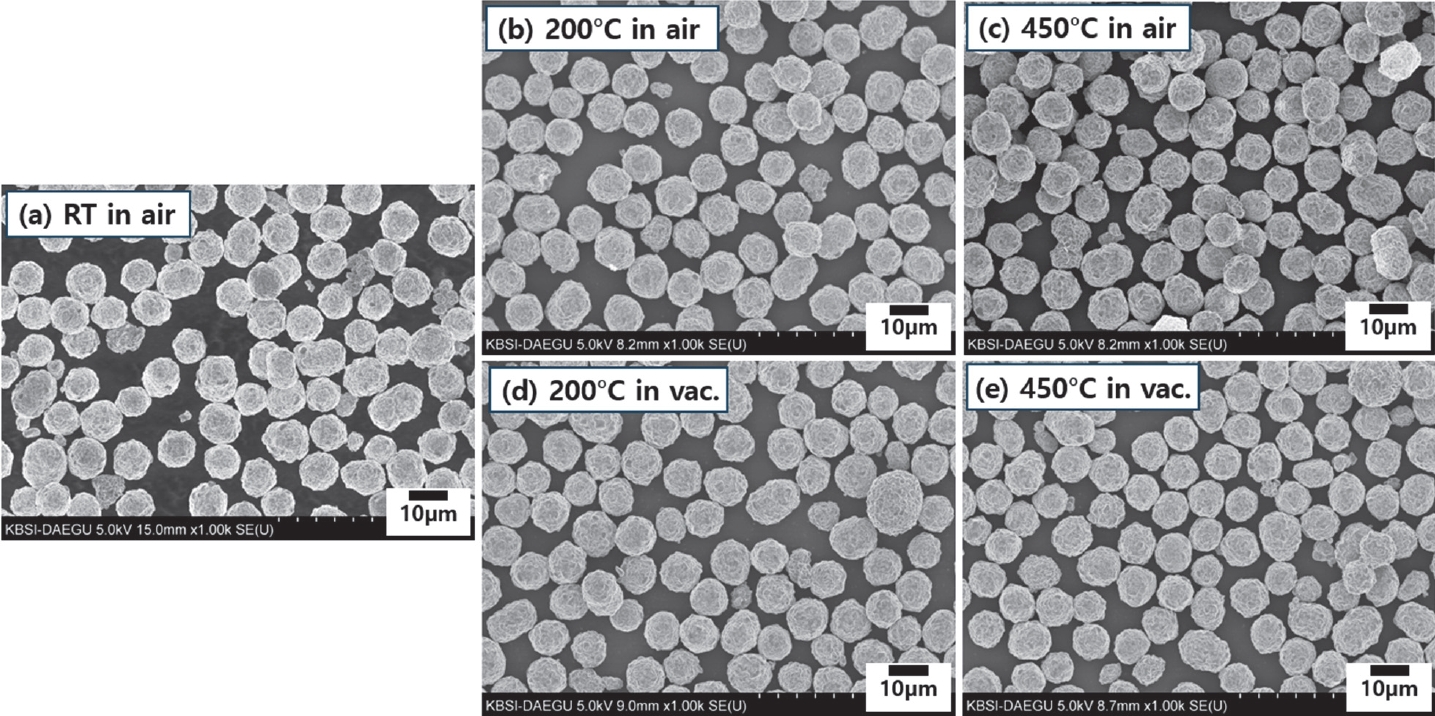
Fig. 2.Mean particle sizes of NCM622 cathode powders as a function of post-annealed temperature in both air and vacuum
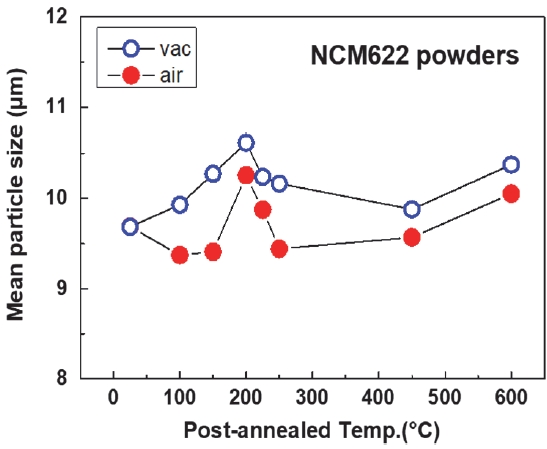
Fig. 3.Synchrotron x-ray diffraction profiles of NCM622 cathode powders at various temperatures during annealing in (a) air and (b) vacuum
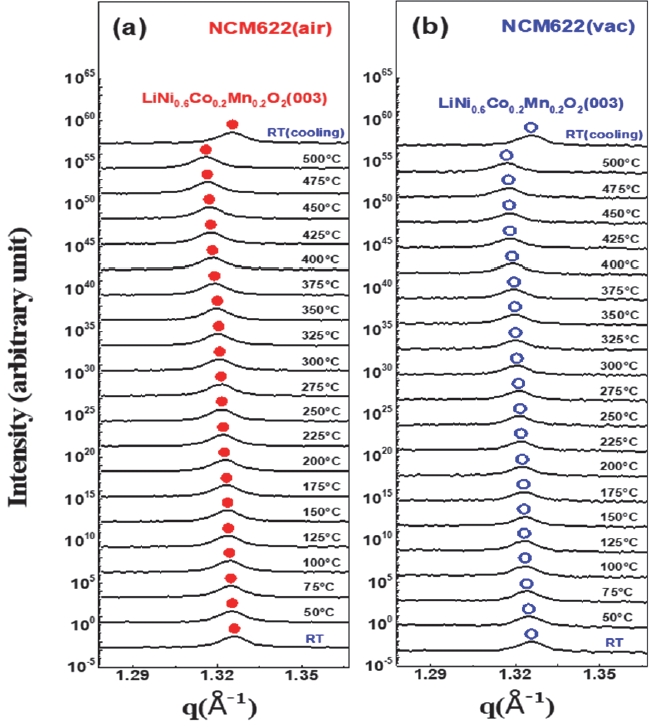
Fig. 4.Thermal expansion coefficients of the (003) Bragg reflection of NCM622 cathode powders as a function of annealing temperature in (a) air and (b) vacuum
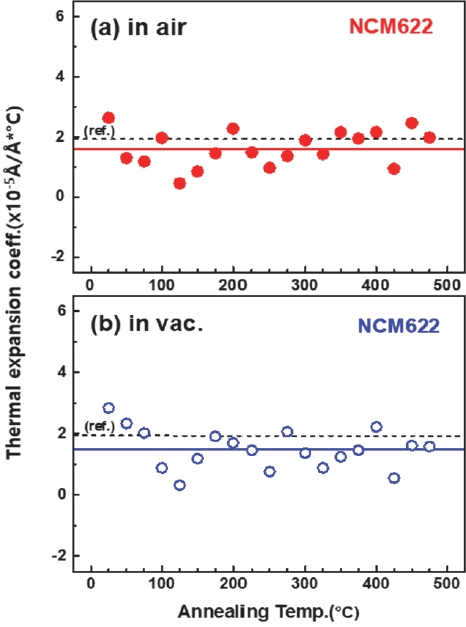
Fig. 5.Integrated intensities of the (003) Bragg reflection of the NCM622 cathode powders as a function of annealing temperature in both air and vacuum
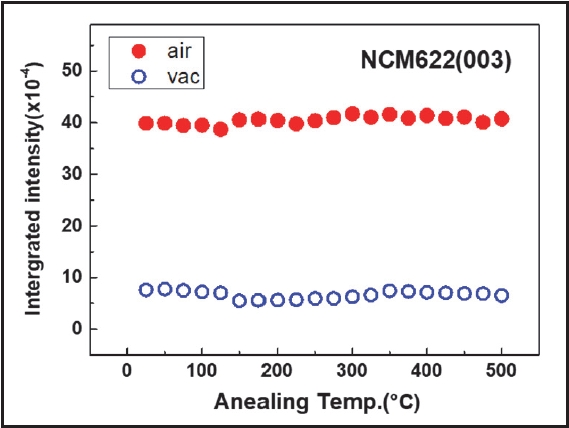
Fig. 6.Crystal domain sizes of the NCM622 phase as a function of annealing temperature in both air and vacuum
References
- 1. T. H. Kim, W. T. Song, D. Y. Son, L. K. Ono, and Y. B. Qi, J. Mater. Chem. A, 7, 2942 (2019). doi: https://doi.org/10.1039/C8TA10513H
- 2. J. B. Goodenough and K. S. Park, J. Am. Chem. Soc., 135, 1167 (2013). doi: https://doi.org/10.1021/ja3091438
- 3. J. H. Park, J. Korean Inst. Electr. Electron. Mater. Eng., 37, 215 (2024). doi: https://doi.org/10.4313/JKEM.2024.37.2.14
- 4. J. W. Wen, Y. Yu, and C. H. Chen, Mater. Express, 2, 197 (2012). doi: https://doi.org/10.1166/mex.2012.1075
- 5. W. C. Jin, Y. S. Choi, Y. S. Oh, J. G. Do, C. W. Park, S. H. Lee, and Y. H. Yun, J. Korean Inst. Electr. Electron. Mater. Eng., 38, 388 (2025). doi: https://doi.org/10.4313/JKEM.2025.38.4.6
- 6. D. D. MacNeil, Z. Lu, and J. R. Dahn, J. Electrochem. Soc., 149, A1332 (2002). doi: https://doi.org/10.1149/1.1505633
- 7. J. H. Kim, K. J. Park, S. J. Kim, C. S. Yoon, and Y. K. Sun, J. Mater. Chem. A, 7, 2694 (2019). doi: https://doi.org/10.1039/C8TA10438G
- 8. J. H. Kim, H. H. Ryu, S. J. Kim, C. S. Yoon, and Y. K. Sun, ACS Appl. Mater. Interfaces, 11, 30936 (2019). doi: https://doi.org/10.1021/acsami.9b09754
- 9. Z. Y. Huang, M. H. Chu, R. Wang, W. M. Zhu, W. G. Zhao, C. Wang, Y. J. Zhang, L. H. He, J. Chen, S. H. Deng, L. W. Mei, W. H. Kan, M. Avdeev, F. Pan, and Y. G. Xiao, Nano Energy, 78, 105194 (2020). doi: https://doi.org/10.1016/j.nanoen.2020.105194
- 10. F. Schipper, E. M. Erickson, C. Erk, J. Y. Shin, F. F. Chesneau, and D. Aurbach, J. Electrochem. Soc., 164, A6220 (2017). doi: https://doi.org/10.1149/2.0351701jes
- 11. J. H. Jeong and T. S. Cho, J. Nanosci. Nanotechnol., 17, 7799 (2017). doi: https://doi.org/10.1166/jnn.2017.14846
- 12. T. S. Cho, J. H. Je, and D. Y. Noh, Appl. Phys. Lett., 76, 303 (2000). doi: https://doi.org/10.1063/1.125727
- 13. S. Y. Kim, S. H. Choi, E. J. Lee, and J. S. Kim, J. Korean Electrochem. Soc., 20, 67 (2017). doi: https://doi.org/10.5229/JKES.2017.20.4.67
- 14. L. W. Liang, K. Du, Z. D. Peng, Y. B. Cao, J. G. Duan, J. B. Jiang, and G. R. Hu, Electrochim. Acta, 130, 82 (2014). doi: https://doi.org/10.1016/j.electacta.2014.02.100
- 15. C. Jiang, Z. Tang, and Z. Zhang, Ceram. Int., 43, 11773 (2017). doi: https://doi.org/10.1016/j.ceramint.2017.06.013
- 16. T. J. Embleton, J. S. Yun, J. H. Choi, J. H. Kim, S. Y. Choi, C. W. Lee, Y. K. Son, and P. G. Oh, Small, 19, 2206576 (2023). doi: https://doi.org/10.1002/smll.202206576
- 17. E. K. Lee, S. A. Muhammad, T. W. Kim, H. C. Kim, W. T. Lee, and W. S. Yoon, Adv. Sci., 7, 1902413 (2020). doi: https://doi.org/10.1002/advs.201902413
- 18. Y. B. Zhu, X. H. Tian, X. Zhou, P. F. Zhang, N. Angulakshmi, and Y. K. Zhou, Electrochim. Acta, 328, 135116 (2019). doi: https://doi.org/10.1016/j.electacta.2019.135116
- 19. B. E. Warren, X-ray Diffraction, 1st edn. (Addison-Wesley Publishing, Reading, MA, 1969)
Citations
Citations to this article as recorded by